
In most cases, medical bills can be wiped out through bankruptcy in New Jersey. Because medical bills are treated as unsecured debt under federal bankruptcy law, they qualify for discharge through either Chapter 7 or Chapter 13 bankruptcy. The right chapter depends on your income, assets, and goals: some people qualify for a faster discharge, while others benefit from a structured repayment plan.
At Straffi & Straffi Attorneys at Law, New Jersey bankruptcy attorney Daniel Straffi, Jr. helps individuals and families throughout Ocean County navigate the bankruptcy process. Our bankruptcy discharge lawyer in Toms River can guide you through filing for Chapter 7 or Chapter 13 bankruptcy and work to help you eliminate medical debt and regain financial stability. We handle cases across Ocean County and throughout New Jersey.
This guide explains how bankruptcy discharges medical debt, what happens during Chapter 7 and Chapter 13 filings, how to qualify, and what alternatives may help before filing.
Medical Bankruptcies Are a Growing Challenge Across the U.S.
Medical debt affects millions of Americans, including many people with insurance. According to the Kaiser Family Foundation, federal survey data estimates that Americans owe at least $220 billion in medical debt.
KFF’s analysis estimates that about 14 million people, or 6% of adults, owe more than $1,000 in medical debt, and about 3 million, or 1% of adults, owe more than $10,000. These figures include people with employer-sponsored insurance, Medicaid, and Medicare.
A widely cited national study of 2007 bankruptcy filers, published in The American Journal of Medicine in 2009, found that 62.1% of bankruptcies met the study’s definition of ‘medical’ bankruptcy, which included filers with substantial medical bills and/or illness-related income loss and related financial actions.
Can You File for Bankruptcy for Medical Debt in New Jersey?
Yes, bankruptcy may eliminate medical debt. Medical bills are classified as nonpriority unsecured debts under federal bankruptcy law. This means they can be discharged completely or restructured and paid off through bankruptcy, depending on the chapter filed.
Chapter 7 Versus Chapter 13 Bankruptcy for Medical Debt
| Feature | Chapter 7 | Chapter 13 |
| Mechanism | Wiped out entirely without a repayment plan. | Consolidated into a 3 to 5-year repayment plan, the unpaid balance is discharged at the end. |
| Speed of Relief | Fast: Debt is discharged within 3 to 6 months. | Gradual: Debt is discharged only upon plan completion. |
| Income Qualification | Must pass the “means test” (income falls below the NJ median or leaves minimal disposable income). | Must have sufficient, consistent income to fund the monthly repayment plan. |
| Medical Debt Limits | No cap; any amount of medical debt can be discharged. | Total unsecured debt (including medical bills) is capped by federal statutory limits. |
| Asset Risk | Non-exempt assets may be liquidated by a trustee to pay creditors. | Assets are kept, but any non-exempt equity increases the total amount you must pay into the plan. |
| Post-Filing Medical Bills | Future bills cannot be added; you cannot file Chapter 7 again for 8 years. | The repayment plan can sometimes be modified if new medical emergencies occur. |
What Is the Statute of Limitations on Medical Debt in New Jersey?
Under New Jersey Revised Statutes Section 2A:14-1, most lawsuits to collect medical debt, typically treated as a contract claim, must be filed within six years after the claim accrues. The specific start date may depend on the facts, and payments or acknowledgments can impact the timing.
If you are sued for medical debt in New Jersey, you must respond within 35 days. Failing to respond allows the court to issue a default judgment against you. A judgment permits creditors to garnish wages or place liens on property.
However, the statute of limitations does not erase the debt. It only prevents legal action. Creditors can still attempt to collect through phone calls and letters unless the debt is discharged through bankruptcy.
How Does Bankruptcy Get Rid of Medical Debt?
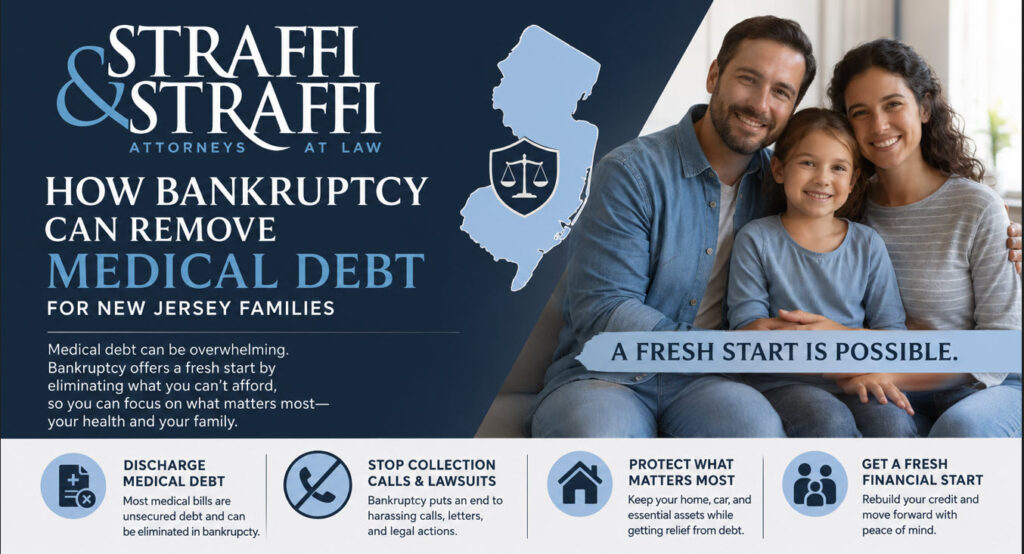
Bankruptcy law treats medical debt as unsecured debt. Unsecured debts have no collateral backing them, unlike mortgages or car loans. Because medical debt is unsecured, it qualifies for discharge in bankruptcy.
The two most common types of personal bankruptcy for medical debt are Chapter 7 and Chapter 13. Each follows different processes under Title 11 of the United States Code, also known as the Bankruptcy Code.
Chapter 7 Bankruptcy
Chapter 7 bankruptcy is also known as liquidation bankruptcy. The U.S. Bankruptcy Court for the District of New Jersey assigns a trustee to oversee your case. The trustee liquidates non-exempt assets to pay creditors. Most unsecured debts, including medical bills, are then discharged.
To qualify for Chapter 7, you must pass the means test. This test compares your household income to New Jersey’s median income for your family size. If your income is below the median, you qualify. If your income exceeds the median, the court reviews your expenses to determine whether you have enough disposable income to repay debts through Chapter 13.
In Chapter 7, certain property exemptions are allowed. New Jersey filers commonly use the federal bankruptcy exemptions, whose dollar amounts are adjusted periodically. For cases filed on or after April 1, 2025, the federal exemptions include a homestead exemption up to $31,575 in equity and a motor vehicle exemption up to $5,025 (subject to the detailed rules and your circumstances). Property that is not protected by applicable exemptions may be sold by the trustee to pay creditors.
Filing for Chapter 7 triggers an automatic stay. Most Chapter 7 cases close within 3 to 6 months, after which your medical debts are discharged.
However, some debts cannot be discharged in Chapter 7. These include child support, alimony, most tax debts, and student loans unless you prove undue hardship in a separate proceeding.
Chapter 13 Bankruptcy
Chapter 13 bankruptcy reorganizes debt into a repayment plan. You make monthly payments to a trustee for 3 to 5 years based on your disposable income. The trustee distributes payments to creditors according to priority rules.
Chapter 13 eligibility debt limits are set by federal law and adjusted periodically. For cases filed on or after April 1, 2025, the limits are separate: unsecured debts must be less than $526,700, and secured debts must be less than $1,580,125.
Chapter 13 generally allows you to keep your property, but your plan must meet Bankruptcy Code requirements. In many cases, that means unsecured creditors must receive at least as much as they would in a Chapter 7 liquidation, which can affect how much you must pay over the plan term.
At the end of the repayment plan, remaining unsecured debts are discharged. This includes medical bills that were not fully repaid during the plan. However, you must complete all required payments to receive a discharge.
Like Chapter 7, filing for Chapter 13 bankruptcy provides an automatic stay that stops collection efforts, lawsuits, and wage garnishments.
What Are the Requirements for Filing Bankruptcy in New Jersey?
Before filing for bankruptcy in New Jersey, you must complete mandatory credit counseling from an approved agency. This counseling session evaluates whether bankruptcy is the right option for your situation. You must complete this within 180 days before filing your petition.
You must also gather financial documents. These include:
- A list of all creditors and the amounts you owe
- Your income sources and amounts for the past six months
- An inventory of all your property and assets
- A list of your monthly living expenses
After filing, you must attend a meeting of creditors, also called a 341 meeting. A bankruptcy trustee conducts this meeting to review your petition and ask questions under oath. Creditors may attend, but rarely do in consumer bankruptcy cases.
Finally, you must complete a debtor education course after filing. This course teaches financial management skills to help you avoid future debt problems. You cannot receive a discharge without completing this course.
New Jersey Bankruptcy Court Locations
The U.S. Bankruptcy Court for the District of New Jersey has three locations. Residents of Ocean County typically file cases at the Trenton courthouse, though jurisdiction covers the entire state.
| Location | Address | Phone |
|---|---|---|
| Newark | Martin Luther King, Jr. Federal Building 50 Walnut Street, Newark, NJ 07102 | (973) 645-4764 |
| Trenton | Clarkson S. Fisher U.S. Courthouse 402 East State Street, Trenton, NJ 08608 | (609) 858-9333 |
| Camden | U.S. Post Office and Courthouse 401 Market Street, Camden, NJ 08101 | (856) 361-2300 |
Bankruptcy Attorney in New Jersey – Straffi & Straffi Attorneys at Law

What Medical Debts Cannot Be Discharged?
Bankruptcy only discharges medical debts that existed before you filed your petition. Any medical bills incurred after the filing date are not included in the bankruptcy estate.
Post-filing medical expenses become new obligations. You must pay these bills even if your bankruptcy case is ongoing or has recently closed. This includes emergency room visits, surgeries, prescription costs, and any other medical care received after filing.
If you expect ongoing medical expenses, discuss this with your bankruptcy attorney before filing. In some cases, delaying the filing date allows you to include anticipated medical bills in the bankruptcy.
Additionally, medical debts secured by property cannot be discharged without surrendering the collateral. For example, if you used a home equity line of credit to pay medical bills, that debt is secured by your home. You must either repay the debt or risk foreclosure.
What Should I Bring to a Bankruptcy Consultation?
Preparing for a bankruptcy consultation helps your attorney evaluate your case accurately. Bring the following documents:
- Recent pay stubs and proof of income
- Tax returns for the past two years
- Bank account statements
- Credit card statements
- Medical bills and collection notices
- Mortgage statements or lease agreements
- Car loan documents
- List of monthly living expenses
If you own a business, bring profit and loss statements for the past year. Bring any documents related to lawsuits, judgments, or liens against you.
Your attorney will review these documents to determine whether you qualify for Chapter 7 or Chapter 13 bankruptcy. The consultation also allows you to ask questions about the process, timeline, and potential outcomes.
Get Guidance on Your Medical Debt from an Ocean County Bankruptcy Attorney
Medical debt can overwhelm even financially responsible families. Unexpected hospital stays, emergency surgeries, and ongoing treatment costs add up quickly. Bankruptcy offers a legal way to eliminate medical bills and regain control of your finances.
New Jersey bankruptcy discharge attorney Daniel Straffi, Jr. has helped individuals and families throughout Ocean County and New Jersey for over 20 years. At Straffi & Straffi Attorneys at Law, we handle filings at the U.S. Bankruptcy Court for the District of New Jersey, prepare required documents, and help you understand your options for eliminating medical debt.
Call Straffi & Straffi Attorneys at Law at (732) 341-3800 for a consultation. Our office in Toms River serves families across Ocean County and throughout New Jersey. We will review your situation, explain whether bankruptcy is right for you, and provide the support you need to eliminate medical debt.


